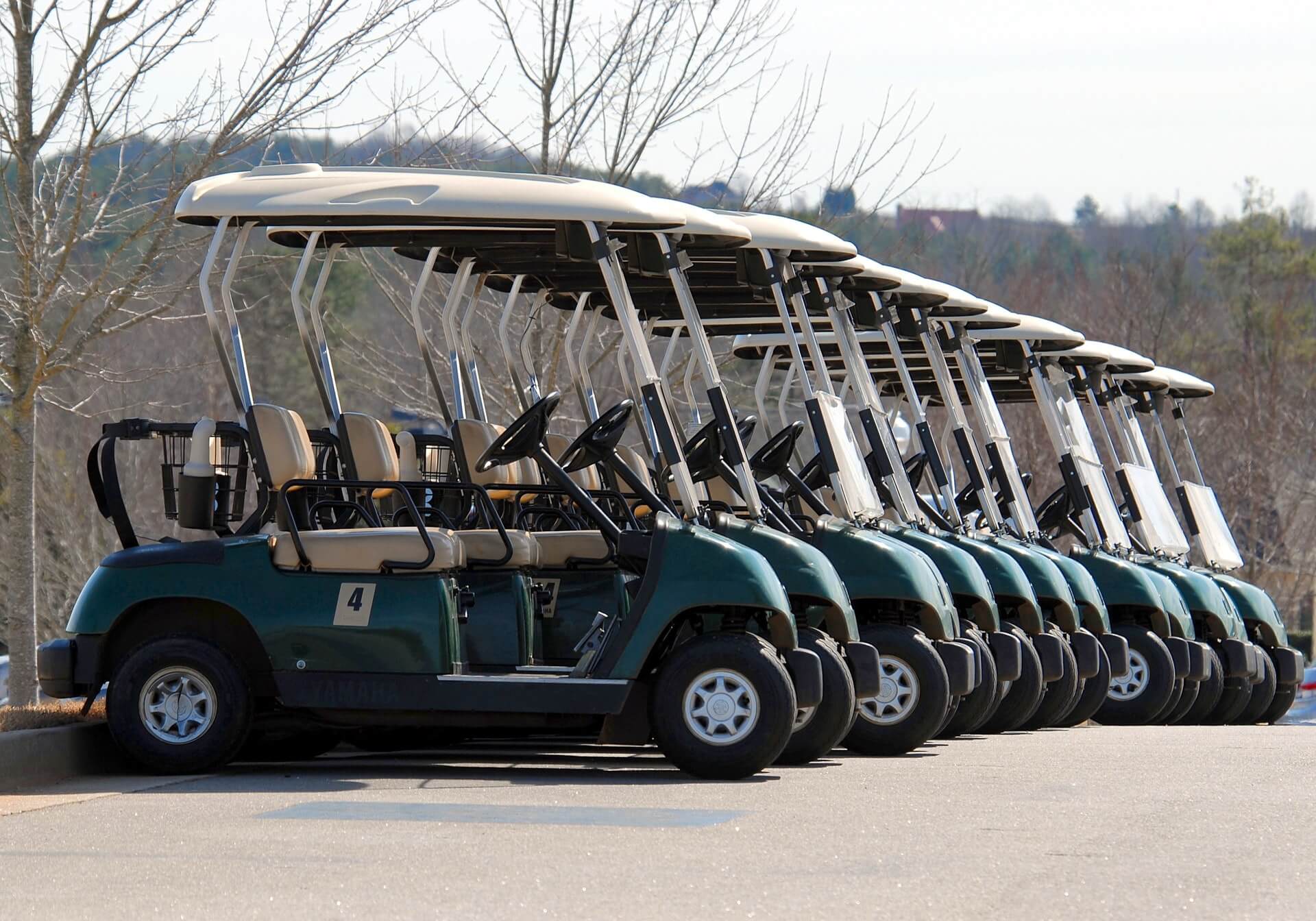
Golf cart batteries are wired in series to make a 36V or 48V pack, so their voltages add up. The common combinations are six 6V (36V), three 12V (36V), eight 6V (48V), six 8V (48V) and four 12V (48V). Match your cart's system voltage first, then choose the chemistry. This page explains how packs are built and compares published maker specs. We have not tested any of these batteries; every figure comes from a maker's page, dated below.
Find your cart's voltage
Count the batteries under the seat, read the voltage printed on one of them and multiply. Six 8V batteries means a 48V system. The system voltage is a fixed property of the cart, so a 36V pack and a 48V pack are not interchangeable.
- 6V x 66V6V6V6V6V6V= 36V
- 8V x 68V8V8V8V8V8V= 48V
- 12V x 312V12V12V= 36V
- 6V x 86V6V6V6V6V6V6V6V= 48V
- 12V x 412V12V12V12V= 48V
| Battery size | Number in series | System voltage |
|---|---|---|
| 6V | 6 | 36V |
| 6V | 8 | 48V |
| 8V | 6 | 48V |
| 12V | 3 | 36V |
| 12V | 4 | 48V |
Battle Born lists six 6V and eight 6V batteries as 36V and 48V packs, and three or four 12V batteries for 36V and 48V. Dakota Lithium says most carts leave the factory with lead-acid 6V, 8V or 12V batteries wired in series to make a 36V or 48V system. Trojan makes an 8V golf cart battery, the T-875.
How series wiring works
Connecting batteries in series, positive terminal to negative terminal, adds their voltages and keeps the amp-hour rating the same, according to Dakota Lithium. Four 12V batteries make 48V at the capacity of one battery.
Battle Born notes that lower-voltage batteries typically have a higher amp-hour capacity, so a pack built from 6V batteries generally has more amp-hour capacity than one built from 12V batteries of the same size. Compare the amp-hour rating on the exact models you are considering.
Build a pack and see the numbers
Pick a battery and a count to see the system voltage, the nominal energy (volts × amp-hours) and the weight of the batteries. The per-battery numbers are the makers' own.
How much energy a pack lists
Energy is voltage times amp-hours, so a pack's capacity in kilowatt-hours lets you compare packs built from different battery sizes. The chart uses the specs on Trojan's and Battle Born's product pages. These are manufacturer claims at the 20-hour rate, and usable energy is lower.
- 48V · eight Trojan T-10510.80 kWh8 x 6V x 225 Ah · 8 x 62 lb
- 48V · Trojan OnePack XR8.75 kWhSingle 171 Ah pack · 8.75 kWh as printed by Trojan, not 48V x 171 Ah (8.2 kWh)
- 48V · six Trojan T-8758.16 kWh6 x 8V x 170 Ah · 6 x 63 lb
- 36V · six Trojan T-1058.10 kWh6 x 6V x 225 Ah · 6 x 62 lb
- 48V · four Trojan T-12757.20 kWh4 x 12V x 150 Ah · 4 x 85 lb
- 36V · three Trojan T-12755.40 kWh3 x 12V x 150 Ah · 3 x 85 lb
- 48V · four Battle Born 100Ah4.80 kWh4 x 12V x 100 Ah · 4 x 31 lb
- 36V · three Battle Born 100Ah3.60 kWh3 x 12V x 100 Ah · 3 x 31 lb
- Flooded lead-acid
- Lithium
The biggest flooded pack here, eight T-105s, lists 10.8 kWh. Trojan's OnePack XR lithium lists 8.75 kWh, a single 171 Ah, 48V unit. Trojan's printed figure is higher than 48 V x 171 Ah (about 8.2 kWh), so it is not on exactly the same basis as our computed packs.
Energy and weight together
Weight matters in a cart, and it separates the chemistries more than energy does. Trojan lists the OnePack XR at 170 lb, while six T-875s list 378 lb for nominal energy within about 7% (8.75 against 8.16 kWh).
- Flooded lead-acid
- Lithium
Lithium is not simply "more of everything". Four 12V Battle Born 100Ah batteries make a 48V pack that lists 4.8 kWh at 124 lb, which is far lighter than the lead-acid packs but also holds less nominal energy. Dakota Lithium says its batteries weigh a quarter as much as a set of lead-acid golf cart batteries without naming the lead-acid pack it compares against.
Lead-acid versus lithium
Lithium (LiFePO4) packs replace flooded lead-acid batteries, which need watering, and the makers state these differences:
- Warranty: Trojan lists a 10-year warranty on its lithium batteries, 3 years on AES AGM and 18 months on flooded lead acid. Dakota Lithium gives 11 years on its golf cart batteries.
- Maintenance: Dakota says its batteries require no watering and can be installed in any orientation.
- Pack layout: Trojan sells 36V and 48V lithium as a single OnePack rather than several batteries. Dakota and Battle Born use 12V batteries wired in series: three for 36V, four for 48V.
- Trojan flooded lead-acid18 months
- Trojan AES AGM3 years
- Trojan lithium10 years
- Dakota Lithium golf cart batteries11 years
- Lead-acid
- Lithium
Cycle life claims
Makers also quote cycle life, but they measure it differently. Trojan says its OnePack lithium reaches 4,000 cycles at 30% depth of discharge and rates its T105-AES AGM at 1,200 cycles at full discharge against 400 for standard AGM. Battle Born gives a range of 3,000 to 5,000 cycles for its 12V 100Ah battery, at what it describes as 100% usable capacity; we could not see its test conditions. Because the depth of discharge differs, you cannot rank the batteries from these numbers alone.
- Standard AGM400 cyclesAt 100% depth of discharge · Trojan’s comparison figure
- Trojan T105-AES (AGM)1,200 cyclesAt 100% depth of discharge · Trojan, "validated"
- Trojan OnePack (lithium)4,000 cyclesAt 30% depth of discharge · Trojan white paper
- Battle Born 12V 100Ah (lithium)3,000 to 5,000 cyclesAt 100% usable capacity, as Battle Born states it · range from Battle Born; test conditions not stated
These sources are battery makers that sell the products they describe, so treat their claims as marketing and compare the specific model you are buying. Lithium packs can need a compatible charger. Trojan's OnePack page points to a charger compatibility guide, and Battle Born lists a 14.2 to 14.6 V charge voltage for its 12V battery, so check with the battery maker before swapping a lead-acid pack for lithium.
Reading the voltage on a lead-acid pack
Trojan publishes the open-circuit voltage of a flooded battery at each state of charge. On a 48V pack it runs from 50.93 V when full to 46.03 V at 10%, and on a 36V pack from 38.20 V to 34.52 V. The table below is Trojan's, for flooded batteries only; lithium batteries have a different voltage curve, so do not use it for them.
- 48V pack (gold line)
- 36V pack (dashed line)
| State of charge | 6V | 8V | 12V | 36V | 48V |
|---|---|---|---|---|---|
| 100% | 6.37 | 8.49 | 12.73 | 38.20 | 50.93 |
| 90% | 6.31 | 8.41 | 12.62 | 37.85 | 50.47 |
| 80% | 6.25 | 8.33 | 12.50 | 37.49 | 49.99 |
| 70% | 6.19 | 8.25 | 12.37 | 37.12 | 49.49 |
| 60% | 6.12 | 8.16 | 12.27 | 36.72 | 48.96 |
| 50% | 6.02 | 8.07 | 12.10 | 36.31 | 48.41 |
| 40% | 5.98 | 7.97 | 11.89 | 35.87 | 47.83 |
| 30% | 5.91 | 7.88 | 11.81 | 35.44 | 47.26 |
| 20% | 5.83 | 7.77 | 11.66 | 34.97 | 46.63 |
| 10% | 5.75 | 7.67 | 11.51 | 34.52 | 46.03 |
Values are reproduced as printed on Trojan's page, which gives open-circuit voltage; they are not our measurements.
Care and safety for lead-acid packs
These points are from Trojan's battery maintenance guidance:
- Trojan recommends checking the water level once a month until you get a feel for how often your batteries need it.
- Use distilled or deionized water only, preferably distilled.
- Add water after the battery has been fully charged, because water is lost when flooded batteries charge. Trojan's level for standard deep-cycle batteries is 1/8 below the bottom of the vent well, and never let the electrolyte drop below the top of the plates.
- Charge only in well-ventilated areas and keep sparks or flames away from a charging battery.
- Trojan does not recommend replacing only some batteries in a flooded bank: older batteries tend to need more charge than newer ones, so new batteries in the same circuit can be overcharged and the charger may stop before the old ones are full.
Flooded batteries contain acid. Wear gloves and eye protection when you handle them, and follow the battery maker's and the cart maker's own instructions for disconnecting and handling a pack.
Golf cart battery reviews by voltage
- Best 6 volt golf cart batteries: 6V options for 36V and 48V packs.
- 12 volt golf cart batteries: 12V options for three- and four-battery packs.
- Best 36 volt golf cart batteries: 36V options.
- 48 volt golf cart batteries: 48V options.
- Evolution golf cart reviews: the Evolution carts we cover.
Source and date
Pack configurations, warranties and care notes checked against the maker pages linked above on 5 October 2026. Battery specifications, cycle claims and the Trojan voltage table were checked on 7 October 2026. Energy figures are our arithmetic on those specs except Trojan's printed 8.75 kWh for the OnePack XR, and all specifications are manufacturer claims, not our test results. Specs and warranties change, so check the maker's current page before you buy.