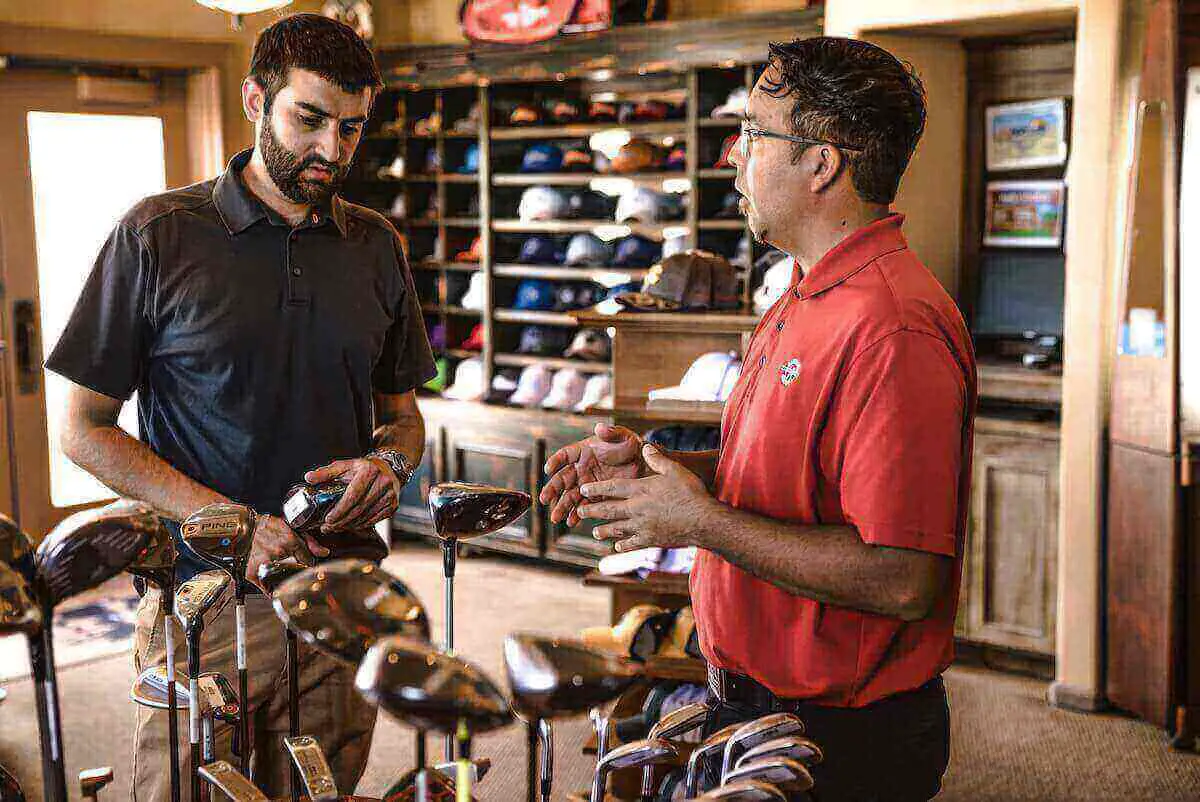
You can get fitted for golf clubs at an independent fitting studio such as Club Champion or True Spec Golf, at a golf retailer, through a manufacturer's fitting program, from a local golf professional or at a university golf program. Prices vary widely. On 7 October 2026, Club Champion listed, as its own page shows, a full-bag fitting at $400 and a driver fitting at $175, True Spec Golf's Bend studio listed up to $475 for a full bag, and Mississippi State University Golf charged $100 for a whole bag and waived the fee if you buy clubs from it. We have not been fitted by these companies; the prices below are from their own pages, with the date we saw them.
Where to get fitted
- Specialist fitting studios. Club Champion and True Spec Golf specialize in fitting. True Spec's Bend page says its fitting matrix covers more than 50,000 clubhead and shaft combinations, lists fittings from $125 for a wedge to $475 for a full bag, and puts a full bag at about 3.5 hours; it says the price is set when you book.
- Golf retailers. Chains such as PGA Tour Superstore and Golf Galaxy may offer fittings. Their pages would not load for us, so we cannot confirm which stores do or what they charge; call your local store and ask what is included and whether the fee is credited toward a purchase.
- Manufacturer fittings. Makers such as Titleist run their own fitting programs (Golf.com describes Titleist's process below). We could not verify any maker's current terms, so check each maker's site.
- Local golf professionals. Belonging to a golf club near you (see golf club membership costs) can give you access to a pro who offers fittings. Ask around.
- University golf programs. Mississippi State University Golf offers fittings on a Foresight CG2 launch monitor, matching you to equipment from Titleist, TaylorMade, Mizuno, PING and Callaway. Its fees are $35 for irons or woods, $50 for both and $100 for the whole bag, waived if you buy clubs from MSU Golf, and 2026 appointments were by request. It is a university program, so check who can book.
What a fitting costs
Club Champion publishes a price and a session length for each type of fitting. These are its regular prices, seen on 7 October 2026.
- Full bag$400 · 3 hr
- Full bag minus putter$325 · 2.5 hr
- Long game$250 · 2 hr
- Driver$175 · 1.5 hr
- Irons and wedges$175 · 1.5 hr
- Fairway wood or hybrid$125 · 1 hr
- Putter$125 · 1 hr
- Wedge$100 · 1 hr
Club Champion's page also listed a $100 full-bag fitting, or $50 for any other fitting type, with a custom equipment purchase, if you book and complete the fitting by 31 October 2026. Two of the three fitters here credit or waive fees against a purchase (True Spec's terms were not stated), so the real cost can depend on whether you buy.
- Club Champion · full bag$400About 3 hours · regular price, 7 October 2026 · fee-credit offer in the text
- True Spec Golf, Bend · full bagup to $475About 3.5 hours · price set when you book · one location
- Mississippi State University Golf · whole bag$100Fee waived if you buy clubs from MSU Golf · irons or woods $35, both $50
Fitting prices change, so check each fitter's own page before you budget. Equipment is the larger bill: Club Champion's page lists custom full bags from $3,300 to $7,900 and irons (a set of seven) from $1,600 to $3,000.
What a fitter measures
A fitting measures your swing and the ball. Mississippi State University Golf lists six measurements it takes with its launch monitor: swing speed, launch angle, spin rate, lie angle, face impact and carry distance. Titleist fitter Lucas Bro told Golf.com in September 2025 that he looks at distance, dispersion and descent angle, which he calls the "3 D's", that every club should separate by about five miles an hour (the article does not say which speed or clubs), and that he wants ball speeds squeezed tight on centered and off-center hits.
- 1Swing speedHow fast the head is moving at impact
- 2Launch angleHow high the ball leaves the face
- 3Spin rateHow much the ball spins
- 4Lie angleHow the sole sits at impact
- 5Face impactWhere on the face you strike it
- 6Carry distanceHow far it flies before landing
Our summary of how a session runs, drawing on these sources: static measurements, launch-monitor testing of heads and shafts, comparing the numbers, then ordering, with the fee sometimes waived or credited. The static part comes first: your height and the distance from your wrist to the floor. PING's color-code chart combines the two to suggest a dot color. In TGW's summary each color stands for a lie angle and a length (red, for example, is 1 degree flat and half an inch shorter). TGW's guide to the chart says to "find your height across the top and your wrist-to-floor measurement down the left side."
Shaft flex and swing speed
Shaft flex is a common question at a fitting, and driver swing speed is a usual starting point. The chart below puts TGW's flex bands next to the TrackMan swing speeds that National Club Golfer reports for male golfers: 93.4 mph for the average male golfer, 95 for a 10 handicap, 101 for a 5 handicap, 110 for a scratch golfer and 113 for the PGA Tour average. A 95 or 110 mph swing sits on a band edge and could be fitted into either flex, which is where a launch monitor matters. TGW calls its bands a starting point, and shaft makers do not all use the same scale, so treat the chart as a way to see where you might begin, not a prescription. Our guides to which shaft suits your swing speed, what regular flex means and shaft torque go further.
- Average male golfer93.4 mph
- 10 handicap95 mph
- 5 handicap101 mph
- Scratch110 mph
- PGA Tour average113 mph
Does fitting actually help?
The evidence is mixed in quality. Plugged In Golf analysed Club Champion's own data on 25 golfers: all 25 gained driving distance, 16 gained more than 10 yards, 6 gained more than 20 and 2 gained more than 40. That is a small sample from a company that sells fittings. A study of more than 250 women golfers on TrackMan, run by researchers working with Club Champion fitters and reported by National Club Golfer, found statistically significant gains in carry distance, total distance and smash factor, and that age, clubhead speed and golf experience did not change how much golfers benefited. We found no large independent study, so weigh these as company-adjacent evidence.
- Gained driving distance25 of 25
- Gained more than 10 yards16 of 25
- Gained more than 20 yards6 of 25
- Gained more than 40 yards2 of 25
Getting the most from a fitting
These are our suggestions, not fitter requirements:
- Ask what is included and what is credited toward a purchase before you book.
- Ask which launch monitor and which heads and shafts they will test, and whether they sell one brand only.
- Bring the clubs you play now if the fitter wants a baseline, and ask how many clubs can be fitted in one session; Club Champion's page lists one to three hours depending on what is fitted.
- Compare ball speed and dispersion, not just distance, as the Titleist fitter suggests.
Related guides
- How to size a golf club: height, arm length and club length.
- How to measure golf shaft length
- How to replace a golf shaft
- How to regrip your golf clubs
- Golf irons by model: specs and lofts
- Golf wedge degree chart
- Golf club guides: shafts, fitting and care
Sources and dates
Prices and session lengths: Club Champion, True Spec Golf Bend and Mississippi State University Golf, all seen 7 October 2026. Process: Golf.com (4 September 2025). Swing speeds: National Club Golfer citing TrackMan, no year given. Flex bands: TGW, a retailer. Evidence: Plugged In Golf (updated 26 January 2020) and National Club Golfer (19 December 2022). Club Champion's page also lists custom full bags at $3,300 to $7,900 and irons at $1,600 to $3,000. We removed price, swing-speed and session-length claims from the earlier version of this page that we could not source. Prices change, so confirm with the fitter.